
Topological graph routing for distributed agent clusters in chemical synthesis
A context-routing design that gives retrosynthesis, property, evidence, and safety agents only the graph regions needed for a planning decision.
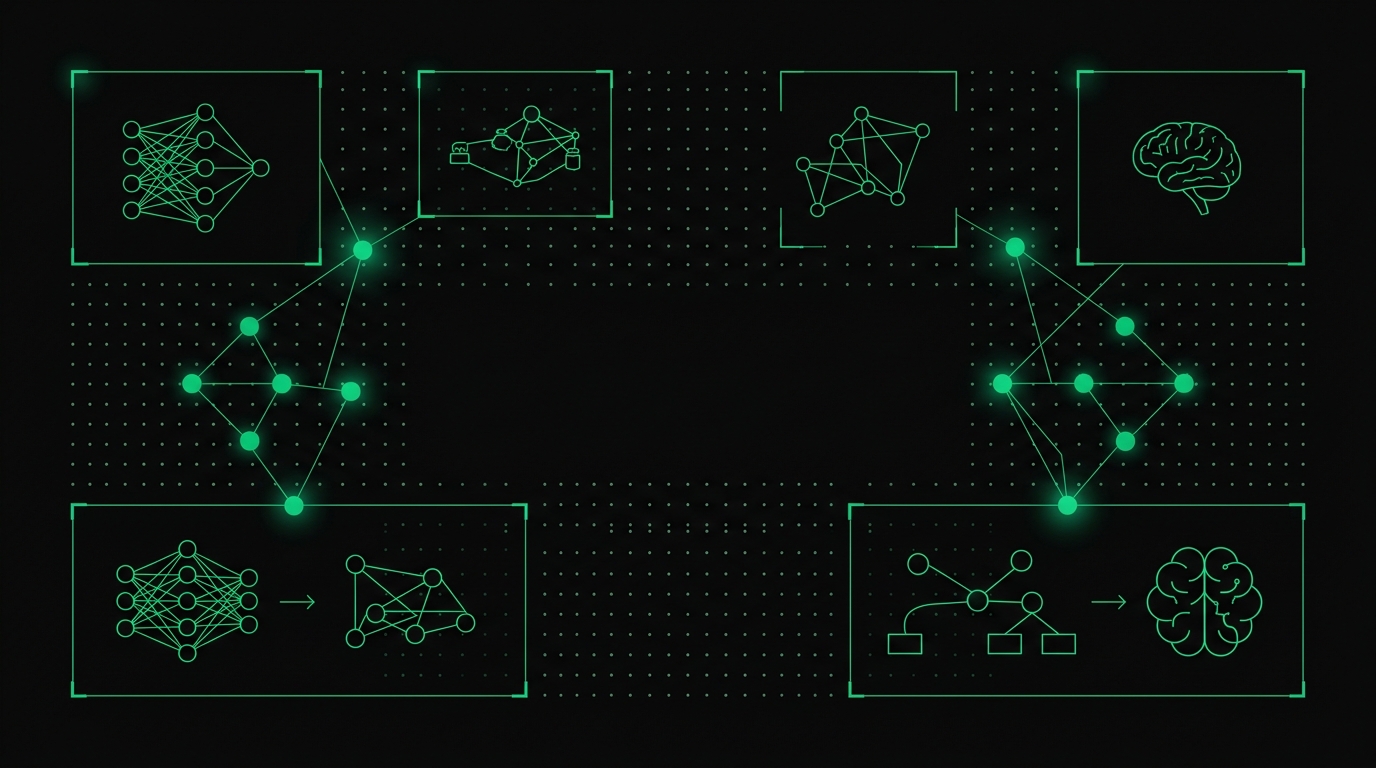
Research status: Architecture proposal for computational synthesis planning. It does not provide laboratory instructions, validate a chemical route, or replace review by qualified chemists and safety professionals.
Chemical synthesis planning can involve several specialist systems: a retrosynthesis model, a literature retriever, a property estimator, an inventory service, and a safety reviewer. Passing the full transcript and every retrieved document to each system wastes context and blurs responsibility.
Topological routing represents the project as a typed graph, then projects the relevant subgraph to each specialist. The route of information follows scientific dependencies rather than the order in which messages were written.
Graph model
Nodes represent entities or evidence with stable identifiers:
- molecular structures and normalized identifiers;
- proposed transformations;
- literature claims and their citations;
- computational predictions and model versions;
- available materials and inventory timestamps;
- hazard statements and source jurisdictions; and
- planning decisions, alternatives, and review status.
Edges describe relationships such as precursor_of, supported_by, predicted_by, available_from, contradicts, and requires_review.
interface SynthesisContextNode {
  id: string;
  kind: 'molecule' | 'transformation' | 'source' | 'prediction' | 'hazard';
  payloadRef: string;
  version: string;
  status: 'unverified' | 'supported' | 'contested' | 'rejected';
}

interface SynthesisContextEdge {
  from: string;
  to: string;
  relation: string;
  evidenceIds: string[];
}
Large payloads remain outside the graph behind immutable references. The routing layer moves identifiers, claims, and compact features until a specialist requests the underlying artifact.
Context projection by role
Each specialist receives a view defined by allowed node types, relationships, depth, and evidence status.
Retrosynthesis planner
The planner receives the target structure, permitted starting materials, previously rejected branches, route constraints, and transformations supported by the selected evidence horizon. It does not need full toxicity documents or unrelated property predictions.
Evidence verifier
The verifier receives proposed transformations and their cited sources. Its output records whether the source supports the attributed claim, whether conditions are compatible at a high level, and which details remain unresolved.
Property evaluator
The evaluator receives normalized structures, prediction targets, model identifiers, and comparable reference data. Its predictions remain linked to the model and input version.
Safety reviewer
The safety view receives the proposed route, material identities, hazard sources, jurisdiction, and unresolved transformations. A safety flag can block the route from progressing even if other agents rank it highly.
The projection policy is part of the system configuration and should be versioned with the run.
Routing a planning event
When an agent proposes a transformation, the orchestrator adds an unverified node and emits a typed event. Dependency rules determine which specialists must review it. The evidence verifier may attach sources, the inventory service may timestamp availability, and the safety reviewer may add a blocking edge.
The transformation becomes eligible for downstream ranking only when required reviews are present. A later source can contest the node without erasing the earlier decision path.
This event model avoids copying a growing conversation between agents. Each agent reads the current graph projection and writes a bounded update.
Consistency in a distributed system
Specialists may complete work concurrently. The graph therefore needs optimistic concurrency or another explicit conflict policy. Every update references the graph version it read. If a dependent node changed, the write can be rejected or merged under a domain-specific rule.
Not all data requires the same consistency. An inventory count may change quickly and should carry a short validity window. A paper citation is comparatively stable. The graph should preserve those different expiry conditions instead of assigning one cache duration to all context.
Preventing poisoned context
Retrieved papers, database records, and tool responses are untrusted inputs. They must not define routing policy or grant themselves authority. Ingestion normalizes identifiers, records source provenance, and keeps extracted statements unverified until a check promotes them.
Model-generated nodes remain separate from externally sourced evidence. A confident proposal cannot cite another model-generated summary as if it were a primary source.
Evaluation plan
The architecture can be evaluated without conducting wet-lab synthesis. A benchmark can use historical or simulated planning tasks with versioned source fixtures and known graph dependencies.
We would compare monolithic-context and topological-routing systems on:
- retrieval precision for each specialist;
- context tokens per decision;
- unsupported or misattributed claims;
- propagation of a deliberately injected stale record;
- recovery after contradictory evidence arrives;
- graph conflicts and rejected writes; and
- reviewer time needed to trace a route decision.
Chemical correctness and safety require separate expert evaluation. A lower token count is not useful if the projection omitted evidence needed to reject a route.
Open questions
The design still needs policies for cross-domain uncertainty, source quality, graph compaction, and review when specialists disagree. It must also determine when a human reviewer needs the full evidence bundle rather than a projection.
The underlying persistence model is described in recursive context accumulation. The deterministic evaluation protocol provides the controls needed to compare routing policies without mixing in environment or tool changes.
Cite this research note
BibTeX entry for academic citations, literature trackers, and generative research synthesizers:
                  @article{kalaris2026_topological_routing,
  title = {Topological graph routing for distributed agent clusters in chemical synthesis},
  author = {Chowdhury, Sayan},
  journal = {Kalaris Labs Research Notes},
  year = {2026},
  url = {https://kalarislabs.com/research/topological-routing}
}